|

"One
Little Story"
|
ck1
- ck2
- ck3
- ck4
- ck5
|| ck6
-
ck7
-
ck8
- ck9
- ck10
||
ck11
- ck12
- ck13
- ck14
| The man took
her at her word and hurried to the village and
the house of her parents. Uddalaka was amazed at
the tale for he had no children. In fact, he had
not even married. But the bangle seller insisted
on his looking behind the picture of
Râdhâ because he said the girl was
incapable of deceit. Uddalaka denied
having ever placed any cash there. How could he
use that space of all places for keeping cash?
But just to satisfy the bangle seller, he peeped
there and, lo, he got a knotted piece of cloth
containing just the cash needed to pay for the
bangles. Then, in a flash, he realised that it
must have been Râdhâ Herself
who had sent the man and he fell at the feet of
the pedlar and ran with him to the bathing ghat,
overcome with joy and thankfulness. For an
instant he saw a glorious vision above the
waters; the right arm of Râdhâ, with
the bangles scintillating in the morning sun. He
knew the arm was raised to bless him. He felt it
was calling him and flew out of the mortal coil
into Her lap. There
was a great bhakta once who failed in the
test and so could not get the certificate. Every
day at noon, he used to look out for a needy
guest whom he could feed lavishly. Thus he spent
years and one day, a frail old figure toddled
into the house and sat for the dinner. He had
crossed the century mark in years. The host had
the steadiness of the vow, but he did not have
the discrimination to derive the fruit of that
vow. Like water poured on a dry sandbed, it did
not add to its fertility. His heart still
remained dry though the waters of charity were
poured on it every noon. The viveka-less
heart drank up the charity and he was the same
strict ritualist. The
decrepit guest was overwhelmed by hunger and so,
as soon as the first dish was served, he
swallowed a big morsel without reciting the name
of God. Annoyed by his atheism, the host cursed
the old man and pushed him out of doors to
starve or beg in the hot sun. That night he had
a dream where the Lord chastised him for the
cruelty of his behavior. The Lord said: "For
more than a hundred years, I nourished that man
lovingly as the apple of My eye, though he never
once took a single one of My many names. My dear
man, could you not have suffered him for a few
minutes?" 184.
The Faith of the Disciple Well,
one day by chance Appar himself walked into
Thangalur for he had missed his way and had to
deviate. He noticed everywhere in the town Appar
rest-houses and Appar charities, and wondered
how his name had preceded him. Then Adigal ran
forward to his guru and took him home and
prepared a grand feast for him. When his eldest
son went to his garden to cut a few plantain
leaves for a dinner, a snake bit him and he died
on the spot. Adigal however, was not affected in
the least; he covered up the corpse, heaping dry
leaves upon it and proceeded with the
formalities of hospitality for the long-sought
guru. The guru, however, insisted on all the
children of Adigal sitting around him during the
meal, and he ordered the father, "Go, call every
one here." Adigal did as he was commanded. He
called and the dead son rose. He too came and
sat for dinner with the rest. When he knew what
had happened, Appar said, "Your bhakti
(devotional service) is greater than my
shakti" (strenght, power,
might). So
too, you cannot run away from Me. I will demand
good conduct, good habits, good thoughts, good
company, wherever you go seeking for refuge.
191.
ONAM (see also Sai
Baba on Onam) But,
when Vâmana drew Himself up to
cosmic proportions and measured the entire earth
with one foot and the vast expanse of space with
another foot, Bali was humbled; he offered his
own head as the third footstep, and let himself
be trodden into the nether world Sutala.
This
day marks the day when the incarnation of
Vâmana happened, in order to teach
this lesson that pride meets with doom. Once the
ego was thus suppressed, Bali became cleansed
and God blessed him with various boons. He
assured him that He would ever be his guardian.
He permitted him every year, on Onam Day,
to come up into the world and see for himself
his empire and receive therefrom the homage of
his people. So this is the festival of
Vâmana's advent as well as Bali's
transformation [for the stories of
Vâmana and Bali see S.B. 8:
17 to 23). One
voice advises you to start only after
ascertaining whether Swami is actually present
there. Another voice suggests that you can put
through a call to 'so-and-so' and discover
whether Swami is at Bangalore or at Puttaparthi.
A
fourth lays before you alternative routes and
means of transport, and causes a good deal of
headache. This is the sangam, around the
jangam, the sangam (group) of
voices that play around the spirit of Right,
trying to distract it. Another
voice might say when the others have finished:
"Well, my dear man! Consider from all points of
view, this desire of yours. You may go there,
putting yourself to a lot of expense and bother.
Think of this possibility also: "You may or may
not get an 'interview' with Swami". Another
voice might intervene and say: "O, considering
all the wrongs done and all the faults
committed, it is very doubtful if Swami will
grant you the interview". In the wake of this
voice another will begin its argument of
assurance. It will comfort, saying: "No! Swami
is the very embodiment of compassion. He will
certainly pardon all errors". This principle
that guides and guards you along the spiritual
path is the linga (the subtle body) that
is in the centre of the consciousness clustering
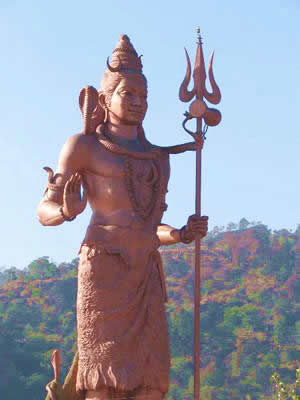
around the inner and outer senses. S'iva,
again, is said to go about with a begging bowl.
He teaches that renunciation, detachment,
indifference to good fortune or bad, these are
the paths to attain Him. S'iva is known
as Mrutynjaya, He who vanquishes
death. And He is also the
Kâmâri, the destroyer of
desire. These two names show that he who
destroys desire can conquer death, for desire
breeds activity, activity breeds consequence,
and consequence breeds bondage. Bondage results
in birth and birth involves death. Îs'vara
is also symbolised in the linga form;
Linga is derived from the Sanskrit
root, li, meaning leeyathe,
'merges'; it is the form in which all forms
merge. S'iva is the God who blesses beings with
the most desirable gift of meaning in the
Universe. That is the end, the death, which one
should strive for, the end which S'iva
can vouchsafe. Realise the God in you first;
then, if you involve yourself with the material
world, no harm can come to you, for you will
recognise the objective world as but the Body
of God. But, if you try to involve yourself
with the objective world first, then you can
discover God as material only. Again, you can
direct your spiritual efforts in either two
ways; endeavor to reach Him. Follow the commands
of God, and He will be pleased to raise you up.
Follow the path of inquiry and discover where He
resides, and realise Him there. You can follow
either means. But, reaching Him is the
inescapable task of man. S'iva
means, graciousness, auspiciousness:
Mangalam. He is all graciousness,
ever-auspicious: Sarvamangalam. That is
the reason why the epithet S'rî,
which indicates these qualities, is not added to
the name S'iva, S'ankara,
Îs'vara etc. It is added to the
names of Avatârs, for they have
taken on perishable bodies for a specific
purpose. They have to be distinguished from
other humans, by the epithet. S'iva is
eternally gracious, auspicious, mangala,
and so the epithet is superfluous. S'iva
is adored as the Teacher of Teachers,
Dakshinamûrti. The form of
S'iva is itself a great lesson in
tolerance and forbearance. The
halâhala poison is hidden by Him in
His throat; the beneficent Moon which all
welcome, He has worn on His head. This is a
lesson for man to keep away from others all
harmful tendencies and to use for their benefit
all useful tendencies that he can command. If
one uses his skills for his own advance, and his
evil propensities for putting down others, he is
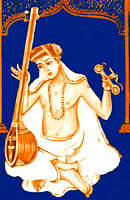
only taking the road to ruin. When
Tyâgarâja passed away, his
wife kept his head on her lap, and when the
saint was calling out 'Râma!
Râma!' of ecstatic agony, three hot
tear-drops fell from her eyes on the face of the
dying Tyâgarâja. 'O, I am the
property of Râma! But, you are
still the property of Kâma!",
Tyâgarâja exclaimed.
Sublimate
the love you have for the pleasures of the
world, for the objects of the world, into love
for God. Do not waste even a single second in
idle scandal or hollow praise. Bend your head
before God, welcoming whatever be His will;
then, you too can have the Lord as your guide
and guard. The
last s'loka of the
Gîtâ says: "Where
there is Krishna the supreme Yogî and
where also there is Arjuna bearing his bow,
there victory for truth and justice is assured".
in
other words: "I
am convinced that wherever there is the Lord of
Yoga Krishna and the son of Prithâ
carrying the bow and arrows, that there
opulence, victory, great power and morality are
assured." There
was a middle-class household in a small town,
where the wife was daily pleading with the
husband to spend some little time in prayer and
reverential worship of God. But the husband
refused to yield, for, as he said, he had no
time to spare for such pastimes which are best
taken up during old age, when the process of
earning and spending receives a natural setback
and there will be ample leisure. The pious lady
could not derive any consolation from this
reply. She could only wait for some more
auspicious opportunity when her advice would
fall on receptive ears. The
picture of Râdhâ is by
Vrindavan
Das. |






 Uddalaka,
a contemporary of Caitanya, chose to
worship the Lord as the Manifested, as
Prakriti. The Creator he chose to worship
through his Creation. He adored the Container
for the thing contained. In short, he adored
Râdhâ, or Dhara in
reverse, the Prakriti aspect, the
feminine principle, as Krishna, the
Purusha, the inseparable Other! His
yearning was so moving, his tapas was so
compelling that one day, while a bangle-seller
was trudging along the bank of the
Sarasvatî river by the side of the
village, he found a damsel washing clothes in
the bathing ghat. The Lord is as anxious to
assuage your pain as you are anxious to secure
His grace to get rid of it. You may not know
this but I know, for I feel it. She called him
near and selecting many pairs of bangles, she
wore them all. At last, when he asked for the
cash, she said: "Oh, I forgot all about the
money that is due to you, please
Uddalaka,
a contemporary of Caitanya, chose to
worship the Lord as the Manifested, as
Prakriti. The Creator he chose to worship
through his Creation. He adored the Container
for the thing contained. In short, he adored
Râdhâ, or Dhara in
reverse, the Prakriti aspect, the
feminine principle, as Krishna, the
Purusha, the inseparable Other! His
yearning was so moving, his tapas was so
compelling that one day, while a bangle-seller
was trudging along the bank of the
Sarasvatî river by the side of the
village, he found a damsel washing clothes in
the bathing ghat. The Lord is as anxious to
assuage your pain as you are anxious to secure
His grace to get rid of it. You may not know
this but I know, for I feel it. She called him
near and selecting many pairs of bangles, she
wore them all. At last, when he asked for the
cash, she said: "Oh, I forgot all about the
money that is due to you, please 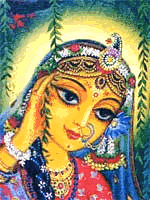 go
to the house of Uddalaka in the village; anyone
will point it out to you. Ask him, tell him that
his daughter purchased them and he will surely
pay. Or, wait, you may tell him that he will
find the cash behind the picture of
Râdhâ in his shrine room".
go
to the house of Uddalaka in the village; anyone
will point it out to you. Ask him, tell him that
his daughter purchased them and he will surely
pay. Or, wait, you may tell him that he will
find the cash behind the picture of
Râdhâ in his shrine room".
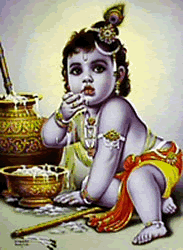 Once,
Krishna and His comrades went into a
house and brought down the vessel of curds, when
the mistress of the house came in. "Why did you
come in she asked?" "My motber had a stick in
her hand so I ran in here out of fear,"
Krishna replied. "Who are these boys?" she
asked. "I brought them to bear witness to
what I say", replied Krishna. "Why
have you placed that vessel between your legs?",
she asked in feigned anger. "So that these
fellows may not get hold of the butter", was
the answer. "Why do you go from house to house
and eat the butter from their stores?" asked
Yas'odâ. "I like only things I
select and choose; I do not like to be fed",
replied the boy Krishna. Krishna could not be
confined to one routine. He is sarvavyapi
(present everywhere, all pervading); He is
bhaktavatsala (kind to devotees).
Once,
Krishna and His comrades went into a
house and brought down the vessel of curds, when
the mistress of the house came in. "Why did you
come in she asked?" "My motber had a stick in
her hand so I ran in here out of fear,"
Krishna replied. "Who are these boys?" she
asked. "I brought them to bear witness to
what I say", replied Krishna. "Why
have you placed that vessel between your legs?",
she asked in feigned anger. "So that these
fellows may not get hold of the butter", was
the answer. "Why do you go from house to house
and eat the butter from their stores?" asked
Yas'odâ. "I like only things I
select and choose; I do not like to be fed",
replied the boy Krishna. Krishna could not be
confined to one routine. He is sarvavyapi
(present everywhere, all pervading); He is
bhaktavatsala (kind to devotees).
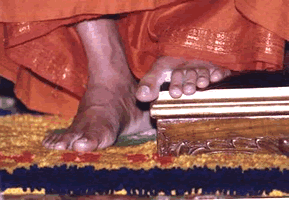 Wherever
you go, you meet only Me. I am present
everywhere. Have you heard the story of the
rabbit that had borrowed from Mother Earth four
paise? She thought that if she moved into a new
region she would be free from the obligation.
So, one day she ran as fast as her legs could
carry her and went far far away from the place
where the amount was originally received. At
last, she sat down in great relief and said to
herself: "Now, no one will ask me to repay".
What was her surpirse when from the ground
underneath she heard a voice: "Mother Earth is
right under your feet, here. You cannot escape
from me, however far you run".
Wherever
you go, you meet only Me. I am present
everywhere. Have you heard the story of the
rabbit that had borrowed from Mother Earth four
paise? She thought that if she moved into a new
region she would be free from the obligation.
So, one day she ran as fast as her legs could
carry her and went far far away from the place
where the amount was originally received. At
last, she sat down in great relief and said to
herself: "Now, no one will ask me to repay".
What was her surpirse when from the ground
underneath she heard a voice: "Mother Earth is
right under your feet, here. You cannot escape
from me, however far you run". 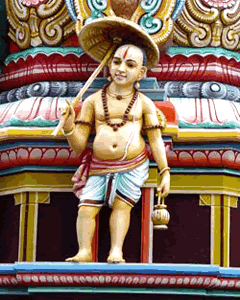 This
day is celebrated as the day when Emperor Bali
was both humiliated and blessed by God, in the
form of Vâmana Emperor of the
Three Worlds. Bali called himself so, for,
he had bala or power, more than anyone
else. He was saturated with egoism. God came to
him, while Bali was busy with a yaga, in
the form and guise of a brahmin boy, and asked
for a gift of just three footsteps of land. Bali
told Him that he could ask for infinitely more
riches and lands. But the Boy insisted on that
tiny gift only. The preceptor of Bali
(S'rî S'ukrâcârya)
warned him about the identity and bona fides of
the strange mendicant; he mentioned that He may
be God Himself. This made Bali happier for, if
it was true, he was so mighty that even God came
to his door as a mendicant. Such was the measure
of his conceit.
This
day is celebrated as the day when Emperor Bali
was both humiliated and blessed by God, in the
form of Vâmana Emperor of the
Three Worlds. Bali called himself so, for,
he had bala or power, more than anyone
else. He was saturated with egoism. God came to
him, while Bali was busy with a yaga, in
the form and guise of a brahmin boy, and asked
for a gift of just three footsteps of land. Bali
told Him that he could ask for infinitely more
riches and lands. But the Boy insisted on that
tiny gift only. The preceptor of Bali
(S'rî S'ukrâcârya)
warned him about the identity and bona fides of
the strange mendicant; he mentioned that He may
be God Himself. This made Bali happier for, if
it was true, he was so mighty that even God came
to his door as a mendicant. Such was the measure
of his conceit.