"One Little
Story"
Part II
Stories and Parables

Quoted
from
the
Divine
Discourses
of
Bhagavân S'rî Sathya Sai Baba
CK2-2
Part II-a  Part II-b Part II-c Part II-b Part II-c

Part
II-a
Stories 1-52
ck2-1 - ck2-2 - ck2-3 - ck2-4
|
Part
II-b
Stories 53-104
ck2-5 - ck2-6 -
ck2-7
-
ck2-8
|
Part
II-c
Stories 105-157
ck2-9 - ck2-10 - ck2-11 - ck2-12
|
| ck2-1 - ck2-2
- ck2-3 - ck2-4 || ck2-5 - ck2-6 - ck2-7
- ck2-8 || ck2-9 - ck2-10 - ck2-11 -
ck2-12 |
14. Mother and Motherland
 S'rî
Râma
and
Lakshmana
aided
by
the
Vanara
army crossed the sea over
the bridge built by them. They conquered Lanka, killed Râvana and
rescued Sîtâ. Lakshmana looked at the city of Lanka in all
its splendor. He remarked: 'Brother, why should we go to Ayodhya? Let
it be ruled by brother Bharatha. Lanka appears in all respects more
prosperous than Ayodhya. You can as well be the ruler of Lanka. You
have earned the merit to be the ruler having won a victory over
Râvana and killed him.' S'rî Râma replied with a
smile in an affectionate but stern voice: 'Oh brother Lakshmana!
However ugly one's mother may be, one cannot look upon another woman as
mother. Similarly however prosperous and attractive Lanka may be, I
have no use for its treasures and wealth; the place of my birth is more
sacred and dear to me. It is verily a paradise for me. Remember
brother, Mother and Motherland are to be considered more valuable and
dearer than heaven itself.' S'rî
Râma
and
Lakshmana
aided
by
the
Vanara
army crossed the sea over
the bridge built by them. They conquered Lanka, killed Râvana and
rescued Sîtâ. Lakshmana looked at the city of Lanka in all
its splendor. He remarked: 'Brother, why should we go to Ayodhya? Let
it be ruled by brother Bharatha. Lanka appears in all respects more
prosperous than Ayodhya. You can as well be the ruler of Lanka. You
have earned the merit to be the ruler having won a victory over
Râvana and killed him.' S'rî Râma replied with a
smile in an affectionate but stern voice: 'Oh brother Lakshmana!
However ugly one's mother may be, one cannot look upon another woman as
mother. Similarly however prosperous and attractive Lanka may be, I
have no use for its treasures and wealth; the place of my birth is more
sacred and dear to me. It is verily a paradise for me. Remember
brother, Mother and Motherland are to be considered more valuable and
dearer than heaven itself.'
 We must note
here that Lakshmana deliberately
asked this
queer question, so as to make it known to the world that even in the
ancient illustrious kings of the Solar Race, as well as in their
succeeding Indian rulers, we find a happy blending of their concern for
personal and national welfare. We must note
here that Lakshmana deliberately
asked this
queer question, so as to make it known to the world that even in the
ancient illustrious kings of the Solar Race, as well as in their
succeeding Indian rulers, we find a happy blending of their concern for
personal and national welfare.
"Maataa Bhoomi putroham prithivyah"
"The earth is my mother and I her child" --- Atharva Veda
15. Patriotism
Subhas
(Chandra)
Bose
was
studying
in the Calcutta University. There was
English professor, who used to speak disparagingly about India and
Indians. Subhas Bose, who
was intensely patriotic, could not bear listening to such denigratory
remarks about the Motherland. He was patient for a while, but when the
professor continued in the same strain, he got up, jumped over three
desks, caught the Englishman by the neck and beat him with sandals.
Bose declared, 'I can bear anything, but I cannot bear my Motherland
being abused and ridiculed. It does not matter what happens to me, but
I must defend my country's honor.'
The students who watched the incident were stunned. The
English professor cried out: "Help me! Help me!". News of the incident
reached the authorities, who held an emergence meeting and rusticated
Subhas Bose for five years. Subhas was determined to dedicate his
entire life to the service of the Motherland. As Subhas could not
continue his studies in Calcutta, his father sent him to London. But
even there Subhas cherished his love for the Motherland. He was
determined to finish his studies and return to India to serve the
Motherland. He studied hard and passed the I.C.S. examination. He
returned to India and plunged into national politics. "I owe my food
and everything else to my country. I must be grateful to the nation by
serving it." This was his firm resolve.

16. 'You shall Speak the Truth'
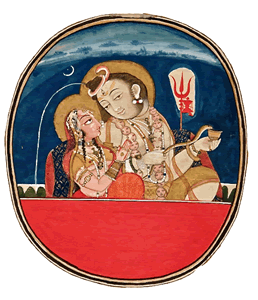
One day goddess Pârvatî asked S'iva:
'Lord, I have heard that there is a sacred shrine for your worship by
name Kasi and that those who visit Kasi and offer worship to you after
a holy bath in the Ganges will earn the merit of coming to Kailas and
stay here forever. Is it true?' Lord S'iva replied: 'All the people
cannot earn that merit. Mere visiting Kasi and offering worship to my
image are not enough. Presently, I shall make the point clear to you.
Let us go to Kasi as an aged couple. I shall make you enact a drama!'
Lord S'iva and Pârvatî appeared before the
entrance of the temple of S'iva, Pârvatî as an old hag of eighty
years and Lord S'iva a rickety old man of ninety. S'iva laid his head
on the lap of Pârvatî and started groaning in
severe pains. The old woman was crying helplessly. She begged every
pilgrim saying: 'Oh ye devotees, look here, this is my husband. He is
terribly thirsty and may die any moment. Will you please fetch some
water for him to drink? I cannot leave him alone and go to fetch
water.' The pilgrims were coming from the ghats after their ceremonial
bath in the Ganges. Their clothes were wet and they were carrying water
in small bright brass vessels. They saw and heard the woman's lament.
Some said: 'Wait, we shall attend to your husband after offering the
sacred Ganges water to Lord Viswanath.'
Some said: 'Oh what a
nuisance. Why can't these beggars allow us at least to offer worship in
peace.' Some others said: 'These beggars should not be allowed to sit
here.'
There was a big crowd near
the temple entrance. A professional pickpocket walked along with some
of these pilgrims. He also heard the old woman's lament. He could not
bear the sight of the suffering old man and the bewailing old woman. He
walked upto them and said: 'Mother, what do you want? Who are you? Why
are you here?' The old woman replied: 'Son, we came here to have the darshan
of Lord Visveswara. My husband suddenly took ill and fainted
out of exhaustion. He might survive if someone were to pour some water
into his parching mouth. His condition is too critical for me to leave
him and go to bring water. I requested many people to help me, but
nobody would spare any water though they have been carrying pitchers
full of it.'
 The thief was moved to compassion. He had brought some
water in the dried gourd-pot. The woman stopped him and said: 'Son, my
husband may die any moment, he will not accept water unless the person
who gives water speaks truth.' The pickpocket could not catch the
meaning. He said: 'Mother, please tell me what I should do.' With a
cynical laughter, he said: 'Mother, I have not done any good deed so
far. I am a professional pickpocket. The only one good deed is that
which I am going to do now, to offer water to this dying old man. This
is true.' He poured gently some water into the mouth of the old man. No
sooner had the pickpocket done this deed than the old couple
disappeared and in their place stood Lord S'iva and Goddess
Pârvatî, in all their full splendor. S'iva said: 'Son, you
are indeed blessed. There is no greater morality than speaking the
truth, and no true worship more fruitful than service to fellow human
beings. You have been atoned for all the sins you have committed so far
because of this one good deed.' The thief was moved to compassion. He had brought some
water in the dried gourd-pot. The woman stopped him and said: 'Son, my
husband may die any moment, he will not accept water unless the person
who gives water speaks truth.' The pickpocket could not catch the
meaning. He said: 'Mother, please tell me what I should do.' With a
cynical laughter, he said: 'Mother, I have not done any good deed so
far. I am a professional pickpocket. The only one good deed is that
which I am going to do now, to offer water to this dying old man. This
is true.' He poured gently some water into the mouth of the old man. No
sooner had the pickpocket done this deed than the old couple
disappeared and in their place stood Lord S'iva and Goddess
Pârvatî, in all their full splendor. S'iva said: 'Son, you
are indeed blessed. There is no greater morality than speaking the
truth, and no true worship more fruitful than service to fellow human
beings. You have been atoned for all the sins you have committed so far
because of this one good deed.'
17. Never Tell Lies even for
Fun
Once there lived a
happy family of four members: father, mother and two children. One day,
the elder of the two, a boy of 12 years was busy studying for his
examination. That day happened to be his birthday. His father was about
to leave for his office. He called his son and said: 'Here take this
gold coin, give it to your mother and let her order for a ring to be
made for you'. The boy thanked his father, kept the gold coin on the
table nearby and once again began reading. His sister came running into
the room and the shining gold coin attracted her attention. She took it
into her hand and asked her brother: 'What is this brother? Who gave
you this?' The brother just to tease her said: 'That is a gold coin,
father gave it to me as the birthday present. Do you also want One?'
The girl was thrilled to hear this. 'Oh! brother tell me how I can get
this coin.' The boy said: 'Oh, it is a very simple affair. The thing
is, you have to wait for some time.' 'Is that so, I shall wait
but how can we get this coin?' asked the girl. 'You just plant this
coin in the soil, daily water it, it will grow into a plant, and then
it will yield fruits; in each fruit we can find a coin' said the boy.
After briefing her about
the process, he resumed his reading. The innocent girl believed her
brother's words, she ran into the backyard with the coin. She dug a
hole near the well, put the coin inside it, and covered it with soil.
She drew a circle round the place. She was very proud of having done a
job, washed her hands and ran into the house. The servant maid who had
been watching the girl putting the coin into the soil, took it out and
calmly walked out.
After some time the mother called her son to come and take his
breakfast. The boy wanted to show the coin to the mother. He
searched for it on the table. It was not there. He called his sister
and asked her where she had kept the coin. Just then the mother came.
The girl was explaining how she had carefully planted the coin in the
backyard. The mother asked: 'What coin, what is this planting?' The boy
explained the entire story to his mother. All the three
hurried to the backyard. They found the
hole empty. The boy began to scold his sister and the girl began to
cry. The mother took both of them inside, and made them sit near her
and said: 'Son, don't cry, today is your birthday. You cannot blame
your sister. She does not know anything about the gold coin. Why did
you tell lies? You should not utter lies even to fooI somebody or for
fun. See what the consequences are. I am not angry. I am only sorry for
you. Remember, never tell lies again even for fun.'
18. Honesty is the Best Policy
Sir
C. V.
Raman (Chandrasekhara Venkata, 1888-1970), a world renowned recipient
of the Noble Prize (for Physics in 1930), was simple and un-assuming by
nature and was respected as a man of integrity and sound character. He
was very kind and charitable too. He spent the entire amount of money
he received as Nobel Prize to establish a Research Institute of Science
in Bangalore. Once he had called for interview candidates for the post
of research assistants in his Institute. Among several young men
interviewed was a young man who was told frankly by Raman that the
chances of his getting selected were almost nil. When the interviews
were over at noon Raman went home for lunch.
When he returned to the
Institute at 3 P.M. in the afternoon, he saw
the young man loitering about, near the office. He called him and said,
in a stern voice: 'Did I not tell you that you will not be selected,
then why are you still here?' The young man replied in humility. 'Sir,
excuse me, I am not here to request you again to select me. I am here
only to return to the accountant of the office, the excess of money he
had paid me towards my travelling allowance by oversight.'
C.V. Raman was surprised and
pleased with the young man's honesty and
integrity. He said: 'Well, my dear boy, do not worry, I am selecting
you now for doing research work in my Institute. Your love of truth and
honesty will always be a good asset for you in your research work as
well as in life.'
19. Means Determine the End
Karna is one of the
greatest heroes and warriors of the Kurukshetra battle. His life long
ambition was to out vie Arjuna in archery. He was in search of a
preceptor from whom he could learn the art and science of archery and
possess rare bows and arrows which would become the most potent
destructive weapons when charged by the power of sacred chants. He was
told that the sage Paras'urâma was the best preceptor and was in
possession of such bows and arrows. He also knew that Paras'urâma
would never condescend to take into his fold a kshatriya
youth as a disciple. He was an arch-enemy of the kshatriya clan. Karna
wondered what he should do. His passion for the possession of the
knowledge of archery was such that he was prepared to hoodwink the
sage. He donned and adomed himself as a brahmin youth and
approached the sage. He conducted himself in such a way that
Paras'urâma was
impressed by him and consented to be his Âcârya.
Karna, endeared himself to his guru, and became his dear and devout
disciple. Within a short time, he learnt from the sage all that one can
learn about archery.
One day Paras'urâma after
instruction felt tired and desired to rest. He kept his head on the
thigh of Karna and slept. He was soon in deep slumber. Karna sat still
lest his slightest movement should awaken his guru. All of a sudden a
bumble bee sneaked underneath the thigh of Karna. Blood was oozing out,
but Karna would not move. He sat still with unimaginable patience and
fortitude. Paras'urâma's matted hair began to get soaked in blood
that was oozing out. He got up and stared at the blood flowing and
Karna sitting still and calm. He raised his eyebrows and asked him
sternly: 'Tell me who you really are, you are not a brahmin by birth, a
brahmin will not bear the sight of blood-shed and withstand such
excruciating pain. You must be a kshatriya, is
it
not?'
Karna
had
to confess his true identity and his life-long passion for
archery that had made him cheat the sage. Paras'urâma said:
'Since you have learnt the art by cheating your guru, what you have
learnt will not be of any use to you at the most critical moment of
your life.'
20. Beware of Anger
 Rajendra Prasad had a very
good servant by name Rathna who was exceptionally faithful and served
him for a long time to the satisfaction of his master. One day he was
asked to clean his room. Rajendra Prasad had kept a pen given to him by
Mahatma Gandhi, in one of his books. When the servant was cleaning the
table the book fell down and the nib broke. He became nervous but told
his master the truth begging his pardon for his mistake. On hearing
this, Rajendra Prasad shouted at him in rage and asked him to get out
and not to show his face again as the pen was a highly valuable gift
from Mahatma which he had broken. Rajendra Prasad had a very
good servant by name Rathna who was exceptionally faithful and served
him for a long time to the satisfaction of his master. One day he was
asked to clean his room. Rajendra Prasad had kept a pen given to him by
Mahatma Gandhi, in one of his books. When the servant was cleaning the
table the book fell down and the nib broke. He became nervous but told
his master the truth begging his pardon for his mistake. On hearing
this, Rajendra Prasad shouted at him in rage and asked him to get out
and not to show his face again as the pen was a highly valuable gift
from Mahatma which he had broken.
The the servant pleaded
that he could not survive without him and sought his forgiveness. But
Rajendra Prasad was in no mood to listen to him and went out bidding
his servant to get out of his sight.
During the night, Rajendra
could not sleep as the memory of his having driven away his servant was
hauting him. When he got up next morning he missed his usual morning
coffee which Rathna would usually serve him. He reflected over his
behavior and felt sorry for having sent out such a faithful servant for
no big fault. He realised that it was his own mistake to have kept the
pen carelessly in a book instead of keeping it in a safe place. He sent
word to Rathna and took him back seeking his pardon saying: "Rathna you
are a good boy. It was my mistake to have kept the pen in the book. So
you must excuse me for my rash action." He asked him to continue to
serve him till the end of his life.
Anger comes from temper
inside and one who yields to this bout of temper is bound to suffer.
You should control anger and avoid talking or acting while in an angry
mood. (An incident from the life of Babu Rajendra Prasad the First
President of India).
21. Arjuna's Pride
Once Arjuna
went towards South India on his conquering expedition. On his coming to
Ramasethu, where Râma had built the
bridge to cross and reach Lanka (see also RRV-7), he was
filled with pride at his unrivalled skill with the bow; he felt that he
was superior even to Râma, for Râma had
piled it up laboriously, stone upon stone. Arjuna said rather aloud:
"If I were Râma, I would have twanged my bow and built an
arch of arrows across the sea, over which the army could have marched
safely along."
Hanuman surprised Arjuna by presenting
himself before him with a grin, which Arjuna felt, made him
even uglier. He challenged him to build one, so that at least one
monkey, that is himself, could walk across, not to speak of the vast
army. It was agreed that should Arjuna fail, he should atone
for his sin of trying to decry Râma because of his vanity
by putting an end to his own life.
Arjuna shot arrows one after another and they got entangled with
one another in such strong interlinks that a huge structure was formed,
bridging India and Lanka. Hanuman declared that it was
too fragile; Arjuna agreed to immolate himself if the bridge
could not stand his weight. Hanuman walked only a few paces on
the bridge when it crashed under his weight and crumbled into the sea!
True to his word, Arjuna lit a fire and was about to enter it
to expiate the sin of pride that made him feel superior to Râma.
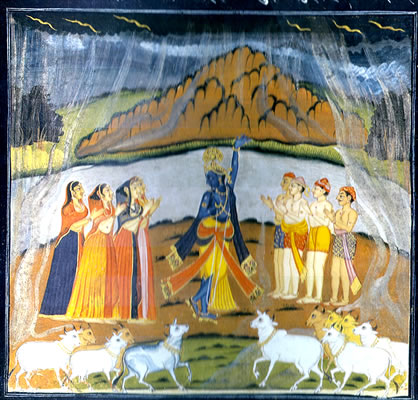 Just then Krishna appeared and asked him
the reason for this strange move of Arjuna, as if he did not
know it. In fact that was the very reason why He had appeared on the
scene. When Krishna was told of the wager and the failure of Arjuna,
He
declared
that
any agreement can be valid only when it was made
before a witness. How could the parties be trusted, since it was their
interest to modify the conditions to their advantage? Just then Krishna appeared and asked him
the reason for this strange move of Arjuna, as if he did not
know it. In fact that was the very reason why He had appeared on the
scene. When Krishna was told of the wager and the failure of Arjuna,
He
declared
that
any agreement can be valid only when it was made
before a witness. How could the parties be trusted, since it was their
interest to modify the conditions to their advantage?
So Lord Krishna wanted the bridge to be built again and Hanuman
to break it again. It was done and Hanuman walked on it as
before, but try as he might with all his strength and weight, the
bridge was absolutely intact. Hanuman jumped on it, but not a
dent was caused. The secret was Krishna, in His subtle form,
was supporting the bridge with His back wherever Hanuman's
steps were placed, the same back that held the Mandara mountain
in position during the epoch making churning of the ocean of milk by
the gods and demons (see SB 8.7).
This
was
noticed
by Arjuna and Hanuman when bleeding
started on Krishna's back. Both the heroes realised that the
Lord had interceded to save the honor of His devotee. Arjuna
was thus humbled. He fell at the feet of Hanuman and prayed to
him for help in his subsequent battles. Hanuman too agreed to
extend his help, realizing that Arjuna was a beloved devotee of
Lord Krishna. Accordingly during the battle of Kurukshetra,
Hanuman was present on the flag of Arjuna's
chariot,
guarding
him
as well as giving the strength till the Kauravas
were finally destroyed.
22. Greed
is the Seed-bed of Grief
There lived two friends in a certain village.
One day, both of them were going together on some work they had to
attend to in the next village. On their way, they had to pass through a
wood. They saw a rider on a horse ahead of them marching towards the
village. A small bundle slipped and fell on the ground from a bag on
the horseback. The rider marched on, unaware of his loss. The two
friends ran and picked up the small bundle. They opened it and were
surprised to find a shining piece of rare precious gem. They were very
happy at this chance incident. One of them said: "My dear friend, you
keep the gem safe with you. I shall go and get some food for both of us
from the village. We shall then talk about the gem." The sight of the
gem had already corrupted the two young men, both desired to become the
sole owner of the gem.
The young man who went to fetch food, quickly finished his meals and
got a meal neatly packed. He then went to a shop and purchased a small
pocket of poison. On his way back to the spot where he was to meet his
friend, he mixed the poison in the food and once again packed it up
neatly and hurried to the place. As soon as the friend gave him the
food packet he said: "You better keep the gem with you, I shall go and
wash my hands in the nearby pond. This young man eagerly took the
bundle and opened it. He bent his head and was looking at it greedily
and joyfully. Suddenly a hard and heavy stick fell upon his head with
such force that he immediately died. Of course it was the other young
man who had hit him on the head. He took the gem, kept it in his
pocket, opened the food pocket and was eating the meal with great
delight. No sooner had he swallowed just two or three morsels, he fell
down dead with his hand on the pocket.
What is the cause of the miserable end of both these young men? It is
lust for wealth. That is greed. Remember, greed is the seed-bed of
grief.
23. Miserliness Leads to Misery
In a certain village there lived
two brothers. Both of them were misers. The younger one could be
rightly called miser and the elder one greater miser. They were so
niggardly that they would not even eat a full meal. They offered
worship to God with the only desire to get more money. At the end of
the worship it is a custom to offer some eatable to God and later eat
it as prasad(am). These brothers would place before the idol a
small bit of sugar candy only for a second because they were afraid
that an ant may bite a piece of it!
One day they received the news of the death of one of their relatives.
The greater miser took upon himself the duty of visiting the bereaved
family and offering condolences. He wanted to set out early next
morning on foot. It was still dark when he woke up, but he decided to
start. As soon as the greater miser left the house, his brother felt
that since the day was about to break, it was unnecessary and waste of
oil to keep the lamp burning. He put out the light and placed it in a
small dark niche in the wall. There was a scorpion and it stung him.
Just within half an hour the greater miser knocked at the door. The
younger brother opened the door and asked him: "Why have you come back,
what is the matter?" The greater miser replied: "Dear brother, I was
only worried that you might have forgotten to put out the lamp; so I
have come back to check up." The younger brother, inspite of the pain
of the scorpion-sting, said: "Alas! What a pity! Don't you know me?
Your desire to avoid wastage of oil is indeed commendable but what
about your sandals. They would have worn out by now by the unnecessary
walking back!" The greater miser immediately replied with a twinkle in
his eyes: "Oh remember, I am your elder brother. I have come
bare-footed with the sandals safe in my bag!" He once again resumed his
journey on bare-foot. On the way in that insect-infested hilly area he
had to cross, he was bitten by a serpent and died.
Such is the misery that miserliness brings.
24. A Man
with Dual Mind is Really Blind
In
a
village
there lived a farmer who used to drive his cattle for grazing
to the forest nearby. A very rich land-lord living in that village had
his cattle driven to the same forest for grazing. This land-lord by
virtue of his property and affluence wielded great influence over the
entire village and was almost a dictator. One day the farmer's bull and
the land-lord's bull entered into a scuffle and the land-lord's bull
was fatally wounded. The farmer was terribly scared and felt nervous to
report the matter to the land-lord. He hurried to the mansion of the
land-lord and said: "Master, today an unusual incident occurred in the
forest". "What is it, come on, tell me", said the land-lord. The farmer
said: "My lord, your bull and my bull entered into a scuffle". "Oh, is
that so? There is nothing unusual about it. Even sensible men are
quarreling with each other", replied the land-lord. "My lord, continued
the farmer, your bull killed my bull". "Oh, is that so? What is unusual
about it, every creature that is born has to die some day or the other"
said the land-lord. The farmer realised suddenly that in his
nervousness he had reported the matter wrongly. He said: "My Lord,
pardon me for the slip of my tongue. It is my bull that killed your
bull". "What?," roared the land-lord. How dare you come and report the
matter to me in such a way? What were you doing when your bull was
wounding my bull? You must be punished suitably". He called the servant
and ordered him to give the farmer twenty hard stripes on his back.
The feeling of mine and thine blinds our judgment and degrades our
nature. Blessed is the person who identifies himself with others and
their sufferings as well as in their joy.
25.
Attachment
Once a farmer took a few acres of land on lease from a zamindar
(landowner) for cultivation for a period of ten years. The farmer with
his hard work developed the farm and raised good crops. The income from
the land steadily increased. He, also paid the rent due to the zamindar
regularly. At the end of the period of the lease, the zamindar's
laborers came to the fields and started ploughing the land. The
farmer's son who was only ten years old and not aware of the lease, got
angry with the laborers and said: "Why are you all here, working in our
fields? This land is ours". The laborers sympathised with him and said:
"Dear boy, this land belongs to the zamindar don't you know? Ask your
father". The boy ran to his father who was at home. With tears in his
eyes, he cried out: "Father, come, quickly. Let us go to our land. The
zamindar has occupied our fields. Let us go and drive away his
laborers." The father made his son sit near him and coolly said: "My
dear son. The field belongs to the zamindar from today. I had taken it
on lease for a period of ten years. Now that the period is over, it is
but proper that he should occupy the land. It is his property".
Why did the boy become miserable and argue with the laborers? He had
nothing to complain against them or the zamindar. It is the feeling of
possession as "Our Land" that made him feel sad and angry. Such
attachment binds man to his possessions and makes him miserable at the
time of parting with them as he must soon or later.
26. The
Fleet-footed Princess
Once upon a time, there lived a beautiful and charming princess in
Greece. She was not only beautiful but also adept in shooting, hunting
and running. In fact, she had earned the title of "the fleet-footed
princess". Many handsome and heroic princes desired to win her heart
and hand. So, the princess hit upon a clever plan. She announced that
she would marry the young man who would beat her in a foot race.
Hundreds of young warriors came to race with her but she always out-ran
them.
At last one young hero was bent upon outrunning her. He sought the
advice of a wise man. He explained to him about the fleet-footed
princess and her challenge. He also expressed his regret over the fact
that many young warriors were being put to shame by the
princess.
The wise man said: "Don't worry, you take within your pocket several
shining pieces of jewellery and gems. As you run, go on dropping one
piece after another on the racing track at strategic points."
On the day fixed for the race, the young man equipped himself with fine
pieces of jewellery. The young man and the princess started running.
Both of them were good runners. Whenever the princess was on the point
of outstripping him, the young man would softly drop a dazzling piece
of jewellery. The princess spontaneously stopped to pick up the lovely
piece of jewellery that was after all on the racing track. She was
confident that in spite of the halts she would be able to outran her
rival. These brief but frequent halts made him reach the goal ahead of
her. Thus the young man won the race as well as the heart and the hand
of the princess. Why did the fleet-footed princess lose this time? It
is all because of her love for jewellery. Love of lucre (money) always
makes man weak and prevents him from realisin g his real goal in life.
If we want success in life, we have to give up attachment and be
prepared to sacrifice what we have as the young man did.

|
|
|
| Index | Vahinis | Biography | Other |